


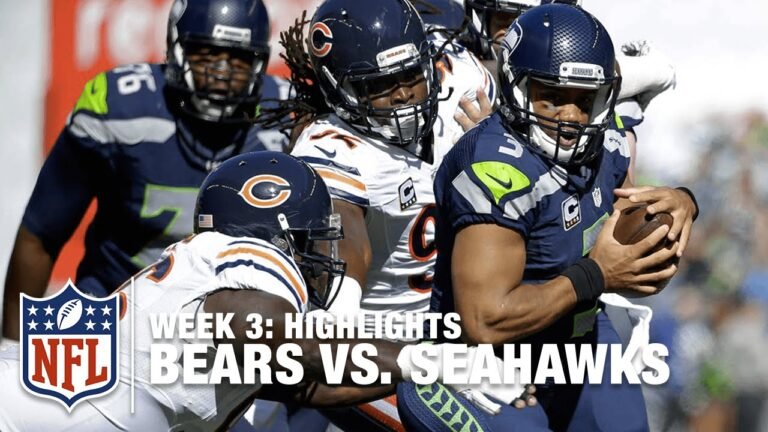
In Week 17 of the 2024 NFL season, the Seattle Seahawks traveled to Soldier Field to face the Chicago Bears in a tightly contested matchup. The game ended in a low-scoring 6–3 victory for Seattle, highlighting a defensive battle where both teams struggled to move the ball consistently. While the scoreboard might suggest a lack of excitement, the player performances and stats reveal a fascinating story of resilience, strategy, and execution.
Game Overview
The game’s final score of 6–3 reflects how evenly matched the teams were in terms of defensive ability. Seattle’s Jason Myers kicked two field goals, which accounted for the team’s entire scoring output, while Chicago’s Eddy Pineiro connected on a single field goal. The Seahawks controlled 29:40 of possession compared to the Bears’ 30:20, indicating a relatively balanced contest in terms of time of possession, but Seattle’s offensive efficiency and defensive dominance were the deciding factors.
Seattle gained a total of 265 yards on the night, while Chicago managed only 179 yards. Seattle averaged 5.2 yards per play, showcasing efficiency even in a tight game. In contrast, the Bears averaged just 3.1 yards per play, highlighting their struggles to sustain drives. Turnovers were even at one apiece, but the seven sacks on Bears quarterback Caleb Williams ultimately tilted the game in Seattle’s favor.
Seahawks Player Stats Highlights
Geno Smith, Seattle’s quarterback, delivered a steady performance. He completed 17 of 23 passes for 160 yards, with no touchdowns or interceptions. Smith’s careful decision-making helped Seattle avoid costly mistakes while managing a game dominated by the trenches.
On the ground, Zach Charbonnet led the Seahawks with 15 carries for 57 yards, averaging just under 4 yards per attempt. Kenny McIntosh provided support with 7 carries for 46 yards, including a long of 25 yards, helping to keep the Bears’ defense honest. Seattle’s rushing attack wasn’t explosive but proved effective in controlling the tempo.
The receiving corps was spread out. Noah Fant caught 4 passes for 43 yards, while D.K. Metcalf added 3 receptions for 42 yards. Jaxon Smith-Njigba contributed 3 catches for 32 yards, and Tyler Lockett grabbed 3 passes for 20 yards. Each of these players helped maintain drives, even without producing a touchdown.
Defensively, Leonard Williams was a standout. He recorded 2 sacks and 5 tackles, spearheading a pass rush that constantly pressured Williams and disrupted Chicago’s passing game. Seattle’s defense, in general, was opportunistic, allowing minimal yards while forcing hurried throws and limiting big plays.
Bears Player Stats Highlights
Caleb Williams, the Bears’ rookie quarterback, had a challenging night. He completed 16 of 28 passes for 122 yards, with 1 interception and no touchdowns. Under constant pressure from Seattle’s defensive front, Williams struggled to find rhythm and was sacked seven times.
Chicago’s ground game featured D’Andre Swift, who carried the ball 12 times for 53 yards, and added 4 catches for 28 yards in the passing game. Williams also contributed on the ground with 5 rushes for 37 yards, including a long run of 16 yards. The Bears’ offense, however, lacked consistency, and the inability to protect the quarterback or convert key third downs proved costly.
Among receivers, D.J. Moore led the team with 6 catches for 54 yards. Keenan Allen added 5 receptions for 25 yards, and Rome Odunze contributed a single catch for 15 yards. Despite these efforts, the Bears were unable to generate enough momentum to threaten Seattle’s lead.
Turning Points and Key Moments
The game’s low scoring highlighted the impact of small margins. Jason Myers’ field goals were critical for Seattle, converting scoring opportunities that were scarce throughout the night. The decisive moment came in the final minutes when Riq Woolen intercepted Caleb Williams, sealing the victory for the Seahawks.
Seattle’s defensive line, led by Leonard Williams, consistently disrupted the Bears’ offense. The seven sacks of Williams not only prevented scoring opportunities but also forced Chicago into negative plays that shifted field position in Seattle’s favor. Meanwhile, Seattle’s offensive line kept Geno Smith mostly unscathed, allowing the Seahawks to maintain possession and control the clock despite a slow-paced game.
Why Stats Matter in This Matchup
At first glance, a 6–3 game might seem uneventful. However, the player stats tell a different story. Seattle’s ability to apply pressure, maintain possession, and capitalize on limited opportunities was decisive. Meanwhile, Chicago’s struggles to protect their quarterback and sustain drives underlined fundamental weaknesses in their offensive line and passing game.
This game reinforces the importance of defensive strategy, field position, and execution in tight contests. In low-scoring affairs, every play, tackle, and sack can determine the outcome.
FAQs
Q1: Who was Seattle’s standout player?
A1: Leonard Williams on defense, with 2 sacks and 5 tackles, alongside Jason Myers’ two crucial field goals, were key to Seattle’s win.
Q2: How did Caleb Williams perform?
A2: He completed 16 of 28 passes for 122 yards with 1 interception, facing significant pressure and seven sacks. His inability to generate consistent drives contributed to the Bears’ loss.
Q3: Who led the Bears’ offense?
A3: D.J. Moore was the top receiver with 6 catches for 54 yards, while D’Andre Swift contributed in both rushing and receiving. However, Chicago’s offense struggled overall.
Q4: How effective was Seattle’s rushing game?
A4: Modest but efficient. Charbonnet rushed for 57 yards and McIntosh for 46 yards, keeping the offense balanced and supporting clock management.
Q5: What was the game’s turning point?
A5: Riq Woolen’s interception in the closing minutes effectively ended Chicago’s comeback hopes, while Seattle’s consistent defensive pressure was decisive throughout.
Q6: What does this mean for both teams?
A6: Seattle keeps its playoff hopes alive, relying on a disciplined defense and opportunistic offense. Chicago must address pass protection issues and offensive consistency moving forward.
Conclusion
The Seahawks’ 6–3 victory over the Bears showcased the impact of strong defense, strategic field management, and clutch plays. Seattle executed its game plan efficiently, relying on key players like Geno Smith, Leonard Williams, and Jason Myers to secure the win. For Chicago, the performance highlighted ongoing offensive line challenges and a need for more consistent execution.
Ultimately, this game was a reminder that football isn’t just about big plays or high scores—sometimes, the battle in the trenches, small strategic advantages, and disciplined execution decide the outcome.
