


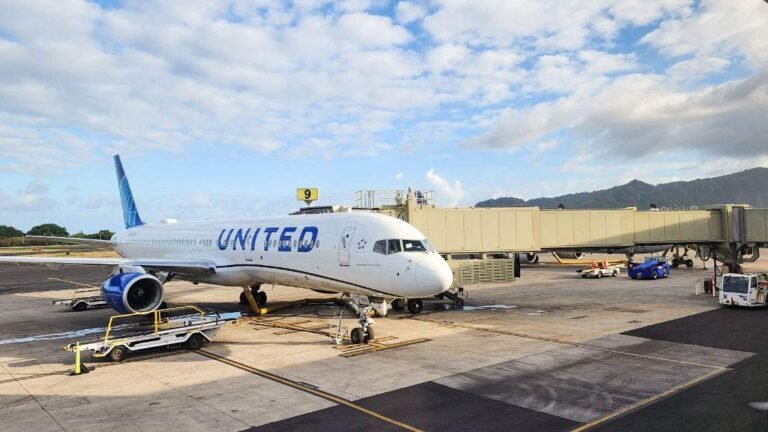
Passengers on United Airlines flight UA731 from Christchurch, New Zealand (CHC) to San Francisco (SFO) recently found themselves making an unexpected stop—in Honolulu, Hawaii (HNL). What was meant to be a smooth, nonstop trans-Pacific journey turned into an unplanned detour that sparked questions and frustration, but ultimately underscored one of aviation’s golden rules: safety comes first.
The Flight That Didn’t Go as Planned
United Flight UA731 is one of the few long-haul connections linking New Zealand’s South Island to the U.S. mainland. The service, operated by a Boeing 787-8 Dreamliner, departed Christchurch around 7:15 p.m. local time, with an estimated flight time of just over 13 hours. For many travelers—business passengers, tourists, and those heading home to the U.S.—it was supposed to be a straightforward overnight journey.
However, a few hours into the flight, the crew identified a technical issue on board. Details have not been officially confirmed by United Airlines, but aviation tracking sources and flight-monitoring websites reported that the crew made the decision to divert the aircraft to Honolulu, rather than continue across the Pacific toward San Francisco.
While the diversion caused inconvenience and confusion for passengers, it was made purely out of caution. Over the Pacific Ocean, where diversion airports are few and far between, safety decisions like this are taken very seriously.
Why Honolulu Was the Logical Choice
For long-haul Pacific flights, Honolulu (Daniel K. Inouye International Airport) is one of the primary designated diversion points. Located roughly midway between Australasia and the U.S. West Coast, Honolulu offers:
- Runways long enough for wide-body jets such as the Boeing 787.
- Full-service maintenance and repair facilities that can handle long-haul aircraft.
- Passenger accommodation and logistics infrastructure, including customs clearance and airline support.
- A United Airlines operational presence, which simplifies handling, crew arrangements, and onward travel coordination.
For these reasons, when something goes wrong mid-ocean—whether it’s a technical issue, a medical emergency, or even weather avoidance—Honolulu is often the safest and most practical place to land.
What Passengers Experienced
According to reports from passengers who shared their experiences on social media, the diversion announcement came after several hours of flight. Cabin crew remained calm, explaining that the aircraft needed to land in Honolulu for “technical reasons.”
Upon arrival in Hawaii, the flight was met by ground crews and maintenance staff. Depending on the length of the delay and the time needed for inspection or repairs, passengers were reportedly provided with accommodation and food vouchers. Some were rebooked on later flights to San Francisco, while others waited until the aircraft was cleared to continue its journey.
For many travelers, the unexpected Hawaiian stopover was an inconvenience—but also a reminder of the complexities of operating ultra-long-haul routes over vast stretches of ocean.
The Costs and Consequences for United Airlines
For airlines, diversions are costly. A stop like this can add tens of thousands of dollars in fuel, ground fees, crew rescheduling, and passenger care. Moreover, a delay disrupts aircraft utilization—since the same aircraft and crew are often scheduled for follow-up flights once they reach their destination.
But despite the expense, safety always overrides operational cost. United Airlines, like all major carriers, follows strict international aviation procedures that prioritize passenger and crew well-being over schedule integrity.
While the exact cause of the issue has not been disclosed, Boeing 787 aircraft are equipped with multiple redundant systems, allowing pilots to detect early anomalies and take precautionary actions. Landing safely in Honolulu demonstrates the crew’s professionalism and adherence to protocol.
Lessons for Travelers
For passengers, this event is a good reminder that air travel—while remarkably reliable—still faces occasional disruptions beyond anyone’s control. Even on nonstop routes, diversions can happen for several reasons:
- Technical or mechanical issues
- Medical emergencies on board
- Adverse weather conditions at the destination
- Airspace or runway restrictions
If your flight diverts, stay calm, follow crew instructions, and remember that the airline’s first priority is to keep you safe. It may be inconvenient, but it’s always better than taking a risk mid-flight.
The Bigger Picture
In the broader sense, events like the United Christchurch–SFO diversion highlight just how advanced and cautious modern aviation has become. Every long-haul flight over the Pacific has contingency plans—alternate airports, fuel reserves, and route flexibility built into its flight plan.
While it made headlines for stranding passengers briefly in Honolulu, the diversion is actually a success story of aviation safety. The crew acted quickly, the aircraft landed safely, and all passengers were cared for until they could continue their journey.
FAQs About the United Christchurch–SFO Diversion
Q1: Why did the United flight divert to Honolulu?
The flight diverted due to a technical issue detected mid-flight. Out of an abundance of caution, the pilots decided to land at Honolulu, the nearest suitable airport with United maintenance facilities.
Q2: Was anyone injured or in danger?
No. Reports confirmed that the diversion was precautionary. All passengers and crew landed safely without incident.
Q3: How long was the delay?
Exact timing varied, but most reports suggest passengers spent several hours in Honolulu before either continuing on to San Francisco or being rebooked on later flights.
Q4: Will passengers receive compensation?
Compensation depends on United’s policy and the reason for the delay. In general, for safety-related technical issues, airlines may not offer monetary compensation, but they usually provide hotel stays, meals, or rebooking options.
Q5: Could this happen again on long-haul flights?
While rare, diversions can happen on any long-haul route. Aircraft constantly monitor their systems, and when something appears irregular, crews follow established safety protocols.
Q6: Is the Boeing 787 still safe to fly?
Absolutely. The Boeing 787 Dreamliner remains one of the most advanced and reliable aircraft in the world. Technical issues occasionally occur on all aircraft types, and the safe handling of this incident reinforces confidence in modern aviation safety systems.
Final Thoughts
The United Christchurch–San Francisco diversion to Honolulu may have disrupted travel plans, but it perfectly illustrates the industry’s safety culture. For those affected, it was an unexpected layover in paradise—but also a reminder that aviation decisions are always guided by one principle above all else: getting everyone on the ground safely.
