


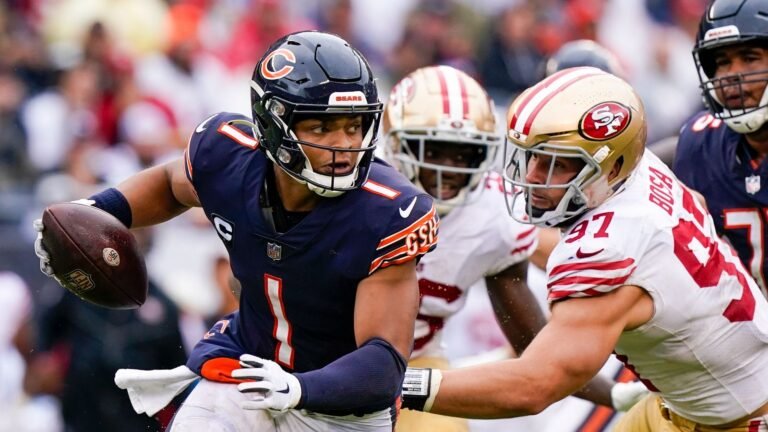
The Chicago Bears and San Francisco 49ers have always brought a mix of history and intensity to their matchups. While they do not face each other every season, whenever the two teams meet, fans expect a game filled with strategic plays, big hits, and standout performances. One recent meeting between these franchises highlighted the gap between a disciplined, well-executed team and one still finding its rhythm. Examining the player statistics from that game provides insight into how both teams performed individually and collectively.
Game Overview
The 49ers dominated the Bears in total yardage, offensive efficiency, and scoring. San Francisco moved the ball with remarkable consistency, amassing over 450 yards while the Bears struggled to reach 170. The 49ers’ offense was balanced, mixing an efficient passing game with a productive rushing attack. Meanwhile, the Bears struggled to generate sustained drives, with their quarterback facing relentless pressure and their running backs consistently limited to small gains.
Time of possession slightly favored San Francisco, although the real difference lay in their efficiency per play. The 49ers averaged over seven yards per play, while the Bears barely managed three yards per play. Turnovers were minimal, with both teams committing just one mistake each, but the 49ers made their plays count, converting key opportunities into points.
Quarterback Performances
For San Francisco, Brock Purdy was the central figure in their offensive success. Completing 80% of his passes, he threw for over 300 yards and recorded two touchdowns without turning the ball over. Purdy demonstrated remarkable poise in the pocket, making quick decisions and hitting his receivers in stride. His ability to read the defense and deliver accurate passes kept the Bears’ secondary off balance and allowed the 49ers to maintain long, sustained drives.
The Bears’ quarterback, a young talent, showed flashes of potential but was constantly under siege from the 49ers’ pass rush. Sacked multiple times and pressured throughout, he managed to throw for over 130 yards and connect on two touchdown passes. However, the consistent pressure disrupted the timing of his throws, and his team struggled to maintain momentum. Despite his individual effort, the lack of support from the offensive line and limited running game made it difficult for the Bears to keep up with the 49ers.
Running Game
San Francisco’s ground attack played a pivotal role in their victory. Their primary running back gained significant yardage on the ground, combining vision, patience, and burst to break tackles and sustain drives. In addition to his rushing contributions, he also proved a threat in the passing game, creating mismatches and forcing the Bears’ linebackers to respect multiple options. The ability to alternate between run and pass effectively kept the Bears guessing and opened up opportunities for big plays.
Conversely, the Bears’ running game was largely ineffective. Their top running back was held to modest gains per carry, unable to consistently move the chains or force the 49ers’ defense to adjust. While he made some effort to gain yards after contact, he lacked the blocking support and gaps necessary to turn short gains into explosive plays. The overall result was a ground game that failed to relieve pressure from the quarterback or control the clock.
Receiving Leaders
The 49ers had standout performances from their receiving corps. Their primary wide receiver caught multiple passes for over 90 yards and scored two crucial touchdowns. Other receivers also contributed key receptions, helping the offense sustain long drives and keep the chains moving. The team’s passing attack was well-distributed, making it difficult for the Bears to focus on any single threat.
For the Bears, one receiver emerged as the leading target, catching several passes and scoring two touchdowns. Another receiver contributed steady yardage, but the passing game struggled overall due to constant pressure on the quarterback and inconsistent offensive line protection. While there were flashes of skill and timing, the Bears’ receivers were not able to consistently challenge the 49ers’ secondary.
Defensive Performance
Defensively, the 49ers applied pressure at crucial moments, registering multiple sacks and tackles for loss. Their pass rush disrupted the Bears’ quarterback and prevented sustained drives, while their secondary remained disciplined, minimizing big plays. Linebackers and defensive backs combined to tackle effectively in the open field, preventing yards after catch and containing the running game. The defense’s ability to maintain gap integrity and execute assignments consistently played a critical role in controlling the game.
The Bears’ defense had moments of success but struggled against the 49ers’ balanced attack. They missed several tackles and were repeatedly caught out of position, allowing the 49ers to gain significant yardage both in the air and on the ground. While individual players recorded tackles and made stops, the unit as a whole could not prevent the sustained drives and scoring opportunities that ultimately led to the loss.
Game Flow and Key Moments
From the outset, the 49ers controlled the pace of the game. Early scoring drives established a lead that the Bears found difficult to overcome. The 49ers scored on their first two drives, one through a short rushing touchdown and another via a precision pass into the end zone. These plays set the tone, forcing the Bears to play catch-up. In the second half, the Bears managed to score on two separate drives, but the 49ers answered both times, maintaining a comfortable lead.
Big plays and turnovers were limited, so the game hinged on execution. San Francisco’s ability to capitalize in the red zone, avoid penalties, and sustain drives was decisive. In contrast, the Bears failed to convert on key third downs and were repeatedly forced into long-yardage situations, further diminishing their scoring opportunities.
Conclusion
The Bears vs. 49ers matchup highlighted the contrast between a disciplined, well-coordinated team and one still building cohesion. San Francisco excelled in all facets: quarterback efficiency, a balanced rushing attack, reliable receivers, and a disruptive defense. The Bears, while showing glimpses of potential, struggled to execute consistently under pressure, both offensively and defensively. Player statistics from the game underscore these differences, with standout individual performances for the 49ers contributing directly to their commanding victory.
FAQs
Q: Who was the top performer of the game?
A: Brock Purdy led the 49ers with over 300 passing yards, two touchdowns, and no turnovers. For the Bears, the young quarterback and their leading receiver made notable contributions, but it was not enough to challenge the 49ers.
Q: How effective was the Bears’ running game?
A: The Bears’ running game struggled to gain consistent yardage, averaging fewer than three yards per carry. Limited gaps and strong 49ers defense prevented significant gains.
Q: Which receivers stood out?
A: For the 49ers, the primary wide receiver scored two touchdowns and gained over 90 yards. The Bears’ top receiver also scored two touchdowns but had limited overall yardage.
Q: How did the defenses compare?
A: The 49ers’ defense applied constant pressure and limited big plays, while the Bears’ defense allowed both substantial rushing and passing yardage.
Q: What determined the game outcome?
A: Consistent execution by the 49ers on offense, efficient quarterback play, and balanced play-calling determined the outcome. The Bears were unable to overcome early deficits or generate sustained drives.
